

FMIC — Antifungal Susceptibility Testing
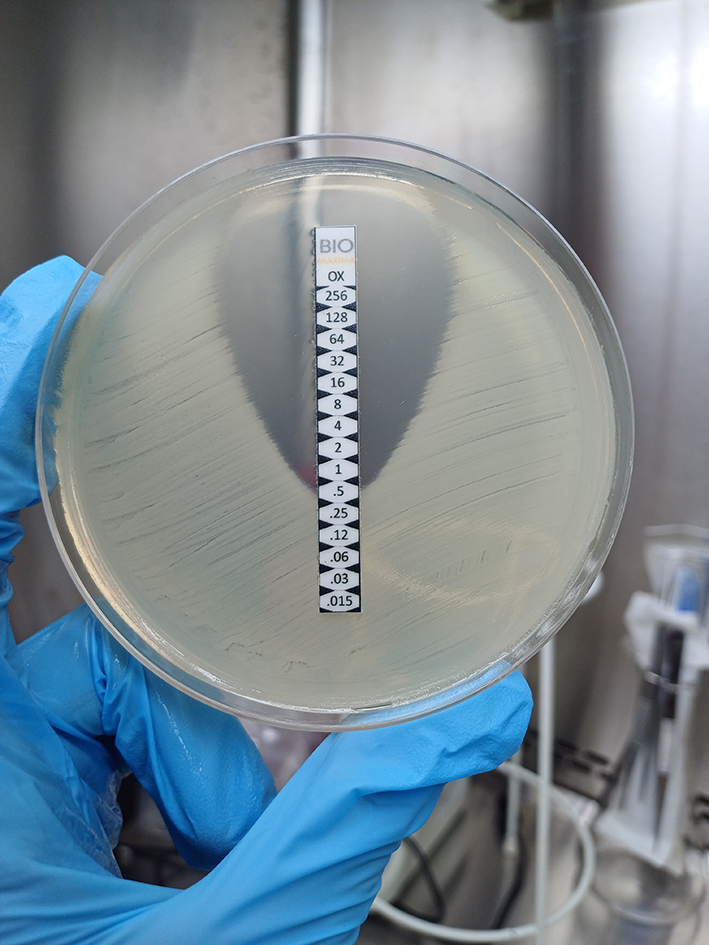
The BioMaxima Fungal MIC Strip (FMIC) delivers quantitative minimum inhibitory concentration (MIC) values for antifungal agents against clinically significant yeasts and moulds using a validated gradient diffusion principle on solid RPMI 1640 agar. A precise antifungal concentration gradient is immobilised along the length of the strip. After lawn inoculation and incubation, an elliptical inhibition zone forms and the MIC is read at the point of intersection with the graduated scale.
The FMIC system supports azole, echinocandin, polyene, and 5-flucytosine susceptibility testing, covering all major antifungal drug classes relevant to candidiasis, invasive aspergillosis, and other systemic fungal infections. Results are interpreted using current EUCAST antifungal susceptibility testing (AFST) breakpoints and, where applicable, EUCAST epidemiological cut-off values (ECOFFs).
FMIC strips are placed on RPMI 1640 agar inoculated with the test organism. After 24 h (Candida) or 48 h (moulds) incubation at 35 ± 1°C, the MIC is read at the point where the ellipse intersects the graduated scale. No serial dilution preparation is required.
Results are interpreted using the current annual edition of EUCAST Clinical Breakpoint Tables or CLSI M100, classifying isolates as S (susceptible), I (susceptible at increased exposure), or R (resistant).
Why BioMaxima FMIC Strips
Developed through university research partnerships and a patented composite substrate — delivering consistent, reproducible gradient diffusion AST.
Biomedical Composite Carrier
FMIC strips use BioMaxima's patented biomedical composite carrier — delivering precise, consistent antifungal diffusion across all 15 two-fold dilution steps with exceptional lot-to-lot reproducibility. Critical for antifungal AST where narrow MIC distributions require accurate gradient delivery.
University-Validated Technology
The MIC test platform was developed through a five-year research programme (2017–2022) in collaboration with UMCS Lublin (Departments of Genetics and Microbiology, and Biochemistry) and the Medical University of Lublin — with two patent applications filed as a result.
EUCAST & CLSI Aligned
FMIC methodology is validated to EUCAST E.DEF 7.3.2 (Candida) and E.DEF 9.3.1 (Aspergillus) reference standards. Results interpreted using current EUCAST AFST clinical breakpoints and ECOFFs from eucast.org/antifungal_susceptibility_testing/.
No Serial Dilution Required
Unlike EUCAST broth microdilution (the AFST reference method), FMIC strips require no preparation of antifungal dilution series. A single strip on RPMI 1640 agar delivers the full 15-step gradient — simplifying antifungal AST without sacrificing accuracy.
Standard Laboratory Infrastructure
FMIC testing requires RPMI 1640 agar, an incubator, and a turbidity standard. No specialist mycology analyser required. Compatible with existing MIC strip applicators. Results in 24 h (Candida) or 48 h (Aspergillus/moulds).
Supports AMR Stewardship
Quantitative MIC values in µg/mL support PK/PD-guided dose optimisation, enabling clinicians and stewardship pharmacists to tailor antibiotic regimens — supporting responsible antimicrobial use and contributing to the reduction of antimicrobial resistance.
FMIC Antifungal Panel — Drug Classes & Organisms
The FMIC range covers all major antifungal drug classes. Individual strips are available for each agent. Contact Advanced Biotech for the current full agent list and catalogue numbers.
Pack Sizes
FMIC strips are individually packaged per antifungal agent. Contact Advanced Biotech for pricing, catalogue numbers, and current availability.
Suitable for low-throughput testing, evaluation, or infrequent use of specific agents. Individually packaged strips maintain stability and reduce waste.
EnquireStandard pack size for routine clinical laboratory use. Cost-effective for regular AST workflows without requiring bulk storage of high-volume packs.
EnquireHigh-volume pack for reference laboratories, high-throughput clinical settings, or institutions requiring bulk supply of frequently tested agents.
EnquireTechnical Specifications
Key technical parameters for the FMIC Fungal MIC Test Strip.
| Parameter | Specification |
|---|---|
| Product name | BioMaxima Fungal MIC Strip (FMIC) |
| Platform | Gradient diffusion minimum inhibitory concentration (MIC) test |
| Target organisms | Aerobic and facultatively anaerobic bacteria (routine clinical isolates) |
| Antibiotic coverage | Broad panel — major antibacterial agent classes (contact Advanced Biotech for current full list) |
| Dilution range | 15 two-fold dilution steps — factory-calibrated continuous gradient |
| Test medium | Mueller-Hinton agar (standard formulation, EUCAST/CLSI specification) |
| Inoculum | 0.5 McFarland turbidity standard — direct colony suspension method |
| Incubation temperature | 35 ± 1°C |
| Incubation duration | 16–20 hours (refer to IFU for organism-specific conditions) |
| MIC reading | µg/mL — read at ellipse/strip intersection point |
| Breakpoint standards | EUCAST Clinical Breakpoint Tables (current edition) / CLSI M100 |
| Pack sizes | 10, 30, 100 tests — individually packaged strips |
| Storage | 2–8°C (refer to product label and IFU) |
| Regulatory category | Class 2 IVD — for in vitro diagnostic use only |
| ARTG number | 524158 |
| Manufacturer | BioMaxima S.A., Lublin, Poland |
| Australian distributor | Advanced Biotech Pty Ltd |
Downloads
Instructions for Use, Safety Data Sheet, and regulatory documentation for FMIC Fungal MIC Test Strips.





Order FMIC or Request Technical Information
Contact Advanced Biotech Pty Ltd for pricing, catalogue numbers, pack sizes, and availability of FMIC Fungal MIC Test Strips in Australia.