
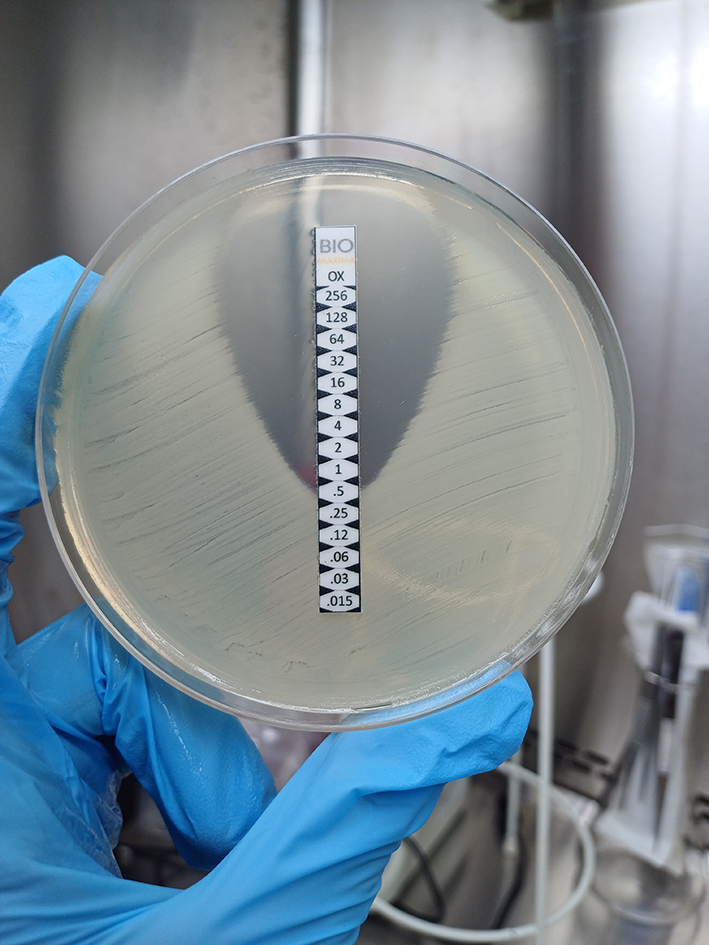
Quantitative MIC Determination by Gradient Diffusion
Antimicrobial susceptibility testing (AST) is essential to clinical microbiology — it determines which antibiotics will inhibit a pathogen's growth and at what concentration, guiding clinicians toward effective therapy and supporting antimicrobial stewardship programmes.
The minimum inhibitory concentration (MIC) is the lowest concentration of an antimicrobial agent that prevents visible growth of a microorganism after a defined incubation period. MIC values in µg/mL, interpreted against current EUCAST or CLSI clinical breakpoint tables, classify isolates as susceptible (S), susceptible at increased exposure (I), or resistant (R).
BioMaxima MIC Test Strips use the gradient diffusion method. Each strip carries a predefined, factory-calibrated antibiotic concentration gradient. When placed on an inoculated agar plate, the agent diffuses outward — after incubation, a teardrop-shaped zone of inhibition forms and the MIC is read in µg/mL directly at the point where the ellipse meets the strip scale. No serial dilution preparation is required.
- Quantitative MIC readout — single numeric value in µg/mL
- No serial dilution preparation required
- EUCAST and CLSI breakpoint compatible
- Standard laboratory infrastructure — no specialist equipment
- Supports PK/PD-guided dose optimisation
- Bacterial and fungal coverage across four product lines
- TGA registered — Class 2 IVD, ARTG 524158
- ISO 13485 manufactured by BioMaxima S.A.
MIC Test Strip Products
Four complementary MIC test strip products covering bacterial routine AST, resistance profiling, antifungal testing, and targeted-agent panels. All registered under ARTG 524158.
BMIC — Broad-Panel MIC Test Strips
Broad-panel gradient diffusion strips for routine bacterial antimicrobial susceptibility testing. Mueller-Hinton agar. 16–20 h incubation at 35 ± 1°C. Covers the major antibacterial agent classes required for routine clinical microbiology AST.
RMIC — Resistance MIC Test Strips
Resistance-mechanism-specific gradient diffusion strips. Targeted panel for CRE, MRSA, VRE, and other priority resistant pathogens. Supports confirmatory MIC testing for organisms with mechanisms of particular clinical and epidemiological importance.
FMIC — Fungal MIC Test Strips
Gradient diffusion strips for antifungal susceptibility testing of clinical fungal isolates. Uses fungal-specific test medium and protocol. Interpreted using EUCAST antifungal breakpoints — not the bacterial breakpoints table.
TMIC — Targeted MIC Test Strips
Curated targeted antibiotic panel for specific resistance-relevant bacterial susceptibility testing. Last-resort agent coverage. Supports MIC determination for agents where standard broad panels may not include sufficient coverage for specific clinical scenarios.
Where MIC Testing Is Used
BioMaxima MIC Test Strips are for professional laboratory use across a broad range of clinical, reference, and public health settings.
Clinical Microbiology Laboratories
Routine and confirmatory AST in hospital and private laboratory settings. MIC values guide empiric and definitive antibiotic therapy selection for clinical isolates across a wide range of specimen types.
Antimicrobial Stewardship
Quantitative MIC data supports PK/PD-guided dose optimisation, de-escalation decisions, and treatment duration reviews — key functions of formal stewardship programmes in healthcare facilities.
Infectious Disease Diagnostics
Precise susceptibility profiling for complex or treatment-refractory infections in infectious disease, intensive care, haematology-oncology, and transplant settings.
Resistance Monitoring & Surveillance
Epidemiological monitoring of MIC distributions and resistance prevalence at local, national, and international levels, contributing data to AMR surveillance networks.
Reference & Public Health Laboratories
Confirmatory MIC testing for outbreak investigations and surveillance mandates. EUCAST ECOFFs support wild-type vs non-wild-type classification for surveillance purposes.
Research & Development
In vitro MIC evaluation for pharmaceutical development, resistance mechanism characterisation, and academic research on bacterial and fungal pathogen susceptibility.
How Gradient Diffusion MIC Testing Works
A straightforward four-step process requiring only standard microbiology laboratory infrastructure. No serial dilution preparation required.
Inoculation
Prepare a bacterial or fungal suspension adjusted to 0.5 McFarland turbidity standard. Inoculate the test medium plate evenly using a swab. Allow the surface to dry before strip application.
Strip Placement
Place the MIC test strip onto the inoculated agar surface with the graduated scale facing up. Ensure full contact with the agar. Apply one strip per antibiotic agent to be tested.
Incubation
Incubate plates at the temperature and duration specified in the product IFU. Conditions vary by product and organism. Do not stack plates during incubation. Examine after the full incubation period.
MIC Interpretation
Read the MIC in µg/mL at the point where the bottom of the ellipse intersects the strip scale. Apply current EUCAST or CLSI breakpoints to classify the isolate as S, I, or R for the tested agent.
Regulatory Information
BioMaxima MIC Test Strips are TGA-registered in vitro diagnostic medical devices for professional laboratory use in Australia.
| ARTG Entry Details | |
|---|---|
| ARTG Number | 524158 |
| Device Class | Class 2 |
| Device Type | In Vitro Diagnostic |
| Products Covered | BMIC · RMIC · FMIC · TMIC |
| Australian Sponsor | Advanced Biotech Pty Ltd |
| Manufacturer | BioMaxima S.A., Poland |
| ARTG Search | tga.gov.au/resources/artg |



For in vitro diagnostic use only. BioMaxima MIC Test Strips are professional laboratory in vitro diagnostic medical devices. They are not for home use, consumer use, or any diagnostic application outside a professional laboratory setting. Results must be interpreted by qualified laboratory professionals using current EUCAST or CLSI clinical breakpoint tables. Australian Sponsor: Advanced Biotech Pty Ltd.
Downloads
Safety Data Sheet covering the full BioMaxima MIC Test Strip family. Product-specific Instructions for Use are available on each product page.


Frequently Asked Questions
Common questions about BioMaxima MIC Test Strips and gradient diffusion antimicrobial susceptibility testing.
Ready to Order or Need Technical Information?
Contact Advanced Biotech Pty Ltd to discuss product selection, pricing, and pack sizes for your laboratory's MIC testing requirements.